February 2021 was one of the coldest months I can remember in Alabama in I don’t even know when. Though I grew up an Army brat and many of the places we lived had plenty of snow, I’ve grown accustomed to Southern winters over the last twenty or so years.
I don’t do cold.
Well, not until I had a farm. The farm doesn’t care if you’re cold. It doesn’t care if you’re sick, and it certainly doesn’t care if you’re tired. Farm work has to be done. And farm work is never done.
About a year ago, we still just had our eighteen chickens. They had settled into life in this new location, and things were going well. Just the daily routine of letting chickens out of the coop and then shutting the door on them at night. Feed. Water. Extra grubs, tomatoes, and pumpkins as treats. Nothing like a little ease to persuade you that farming is a walk in the park.
Until the ice storm hit. We knew a storm was coming; we had no idea that it would be that cold.
My mom, brother, sister, and brother-in-law had come to help us fix up the barn and run pasture fencing in anticipation of the arrival of our goat kids. (Fortunately for us, my brother-in-law had taken a new job in Huntsville, Alabama, and their family had moved from Mississippi just a couple months before we moved into the farmhouse in December 2020. So at least they were close by to help us, and they didn’t have to worry about traveling in dangerous winter weather.) It was already getting cold. We worked tirelessly for days, bundled up in as many layers as would still allow us to walk, trying to prepare everything for the new animals.
We had already driven five hours one way into Georgia to get our livestock guardian dog (puppy) at the very end of January, and she was still living in the house until the barn could be repaired and shored up so that it would be safe for her, as well as for the goats who would soon be living there. In fact, we were working so relentlessly in the frigid weather because those goats would be making their arrival on our farm within the week. (That wasn’t the original plan, but that’s a story for another day – more on that later). Time was of the essence.
Working in the cold is awful. You don’t have much dexterity because of the gloves, but if you take off your gloves in order to work better/faster, you run the risk of frostbite. And it didn’t take but a minute or two before our fingers started stinging and turning red. So trying to run wire and fencing, driving T-posts into the hard ground, and just moving were no easy tasks. The wind whipped around us, stealing our breath, making it difficult to utter words. We all wanted to quit. I’m pretty sure my brother-in-law dreads it when I ask him for help on the farm, now, as a result. Strike that. I know he dreads it. He has told me as much. Yet still we labored.
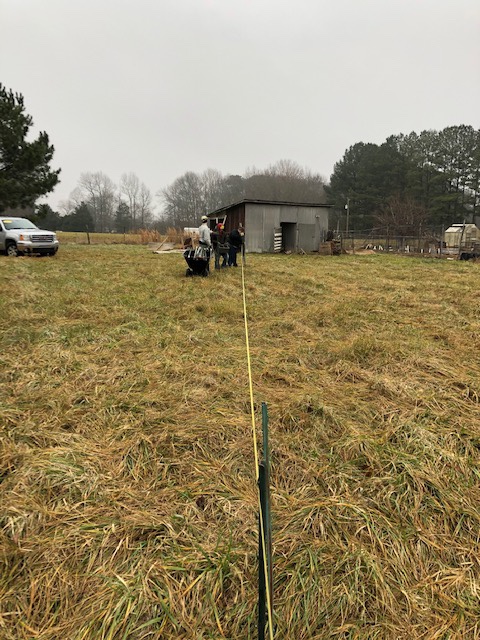
We got the fencing put up and the barn repaired. I say that in one sentence, and it seems like it was easy. It wasn’t.
Some of the repair work included removing rotten boards from the roofline and replacing them, tearing out an old wall, putting up a new wall, and stabilizing the center of the barn.
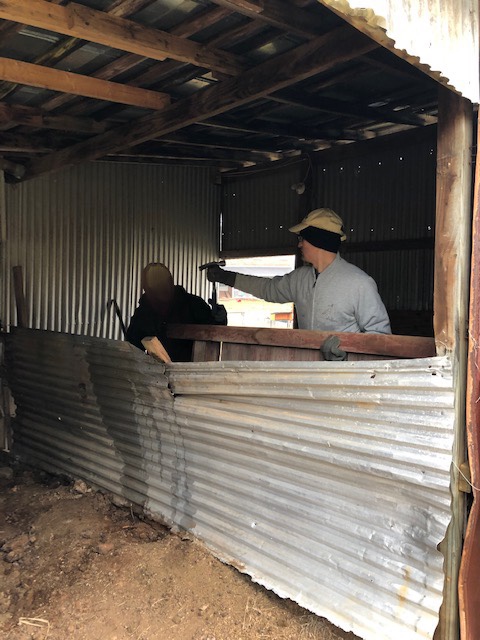
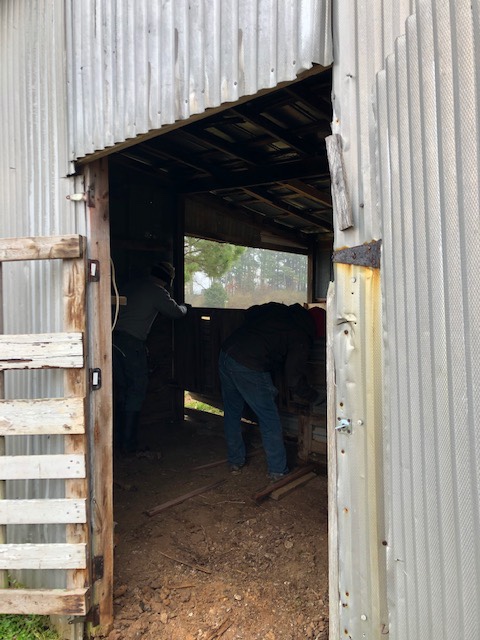
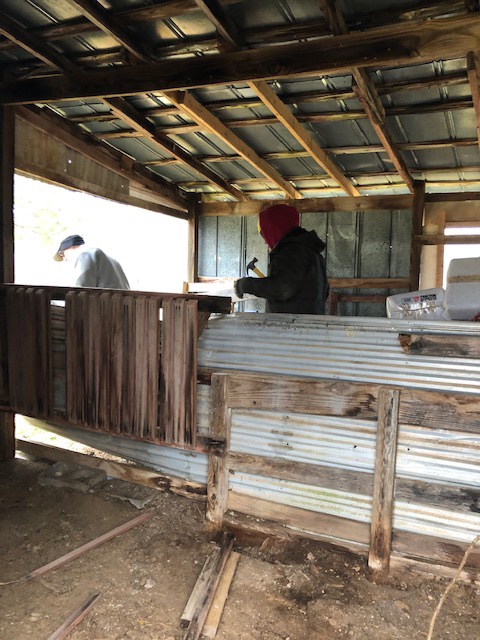
There was a point when Hubby looked at my mom, sister, and me, and he said, “You ladies need to leave the barn when we install this beam just in case it all comes down on us. I’m serious. Please leave.” We all had our phones ready to dial 9-1-1 if such a need arose.
See, the former owners of our home at one time had a little farm of their own. They had miniature goats of some sort, and we’re not sure if they ran a business, or if they just kept the goats as pets. Either way, they had built a barn some thirty-five years prior. And there were some issues with the quality of workmanship, let’s just say.
So when my hubby said they had to install a beam, what they were actually doing was leveraging their own bodies against the weight of the barn roof in order to fit a vertical support beam between the ground and the roof.
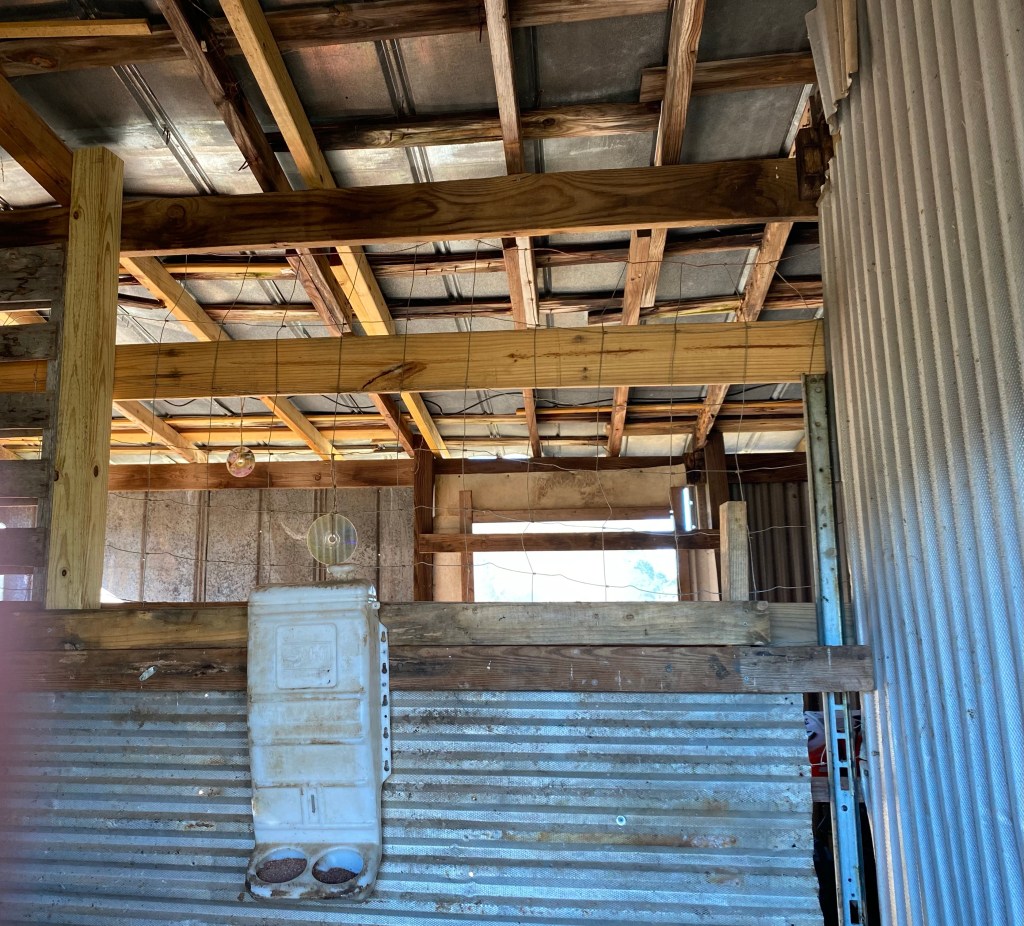
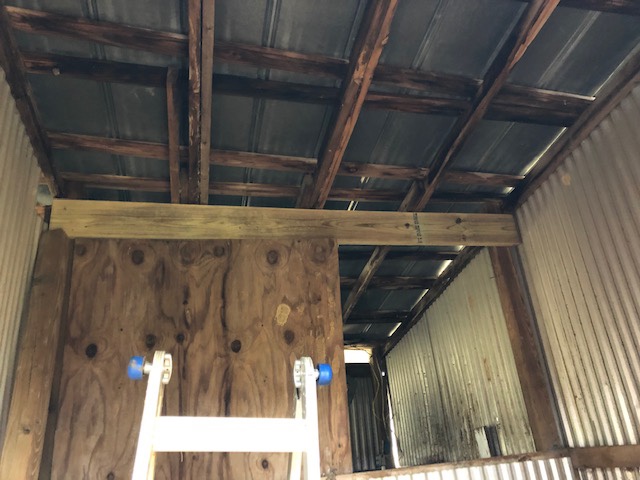
How this barn was still standing before this, I don’t even know. At least the angels holding it up for thirty-five years could finally rest their wings.
If my brother-in-law ever had any inkling that farming might be for him, this experience broke him of that real quick.
He did come back to help us build our second chicken coop in the spring, but I’m pretty sure he’s sworn off any major barn work from here on out. Farm living is not the life for him. I don’t blame him; it’s not the life for most people.
So, we got the barn fixed up for the goats and the livestock guardian pup, and we thought we were done with any major farm work until spring. Everything looked great. We put away the tools and cleaned up.
In all of this prep for the goats and dog, and assuming the chickens were running on maintenance at this point and were ready for winter, I went out to the coop to do my usual nighttime chicken routine.
Now, I knew from research that chickens, in theory, can be pretty cold hardy, depending on breed. Some are less cold hardy than others, mostly dependent upon the size and makeup of their combs and wattles.
Their bodies run about 104 degrees, and when they’re cold, they huddle together on their roosts for warmth. I had learned all about deep bedding and wrapping the coop in plastic sheeting to help block drafts and create insulation for them, and I had even been checking their combs and wattles for signs of frostbite. Just to be safe, I had even applied my own homemade salve to their combs and wattles to make sure they were protected from the cold.
And even with all these precautions, I thought, “This is Alabama. Even in a winter storm, it won’t ever get cold enough that anything beyond these measures will be necessary. Farm animals are made for this type of thing.”
Or so I thought.
I didn’t count on the freakishly cold ice storm during the winter of 2021 blowing through, threatening to freeze my chickens’ feet to the very roosts on which they were sleeping. It was cold while we had been working on the barn, but as the sun started going down and the temperature dropped below what I thought possible in Alabama, this was about to be a winter storm anything other than typical.
The first sign of trouble became apparent when I saw that there were no chickens in the yard. They normally love their free range time, and even in the cold, they can’t be kept inside. My chickens love to roam free, but this was different.
As my heart pounded and I wondered if a predator had somehow gotten to them, I made my way to the coop. There they all were, huddled together on the roosting bars, each one standing on one foot. This is not normal chicken behavior.
Chickens are not flamingos. They don’t just stand around on one foot for fun. In this type of weather, it could mean only one thing. The birds were freezing to death.
When chickens roost for the night, they like to have a wide surface to place their feet. Some birds curl their feet around a perch, but this can actually be damaging to a chicken’s feet. They prefer to sleep flat-footed (which is why the roosting bars in my coops are 2×4 beams), and then they lower their bodies on top of their feet. This is how they keep their feet warm.
A chicken who is freezing during the day will stay standing, while drawing one foot at a time up into its body in an attempt to keep that foot warm. Then it will switch sides and lift the other foot. It’s a very good indication that your birds are way too cold. Dangerously cold.
Upon seeing this, I knew something had to be done, or my chickens were going to die. I ran to Hubby and told him, “The chickens are freezing to their roosts, and they won’t make it through the night if we don’t do something before dark.” He said, “Okay, I hear you; I agree, but where are we going to put them?”
The only logical place for them at the time was the basement. We considered the garage, but we keep tools, farm supplies, chicken feed, an extra fridge, and all sorts of home-use items in the garage, and at the time we were even parking our vehicles in there, so that just wasn’t going to work. Hubby didn’t want his truck getting walked on by eighteen chickens. Honestly, I don’t blame him.
The basement made the most sense at the time because we were using that area for Christmas box storage and not much else. Everything down there would be safe from chicken feet… and other chicken things.
We all worked to build a sort of enclosed/barricaded area in the basement, to help keep the birds in one location, and when we had that secured, we began moving the chickens to their new, temporary home.
We have an exterior door to our basement, so we didn’t even have to bring my poor birds through the house, which was good, because Hubby is actually allergic to bird feathers. No birds in the actual house, and the chickens would still be kept safe. It was a great plan!
The hens probably have a different memory of the events that transpired next.
Have you ever been going about your life when it takes an unexpected turn, and if so, what was that like? I’d imagine, if you’re anything like me, that deviations from your picture-perfect plan are more than enough to induce at least a little anxiety. Maybe some sleepless nights. Maybe even a panic attack or two. The same can be said for poultry.
I tend to think of my hens as pretty smart, and I guess as far as birds go, they are. But even if their brains are small, they are still creatures of routine. They know when it’s time to wake up and leave the coop. They know how to coop themselves for the night (that took a little training, but they do it on their own now).
Agnes the Easter Egger loves tomatoes, and she knows just where to hide bits and pieces of her favorite fruit so she doesn’t have to share. Penelope the Silkie is a master at hiding from predators and has survived two separate dog attacks. Gloria the White Leghorn knows her name and comes when called, and she will even sit on my shoulder like a parrot.
They each have their own distinct personality, and I love them all dearly. I know my chickens, and my chickens know me.
But even as smart as I believe them to be, and even as much as they rely on me for their care, nothing could have prepared them for what was about to transpire. They just wanted to feel safe and warm, and in the middle of an ice storm where they were literally freezing where they stood, they had to have felt anything but.
Little did they know, their caretaker had a plan.
Hubby and I began transporting the flock to the basement, chicken by chicken. They bawked, squawked, flapped, tried to wriggle free, and in every way possible, threw a little hen tantrum. All the way from the chicken yard to the basement steps, these poor birds must have thought, “This is it; I’m about to be stew. I saw Dorothy go down those stairs, and she hasn’t come back yet.” Or at least you’d think those were their thoughts, given the measures each one took at escaping.
I tucked each one under my arm, spoke gently to them, stroked their backs, and said, “You’re safe. I’ve got you. I know where we’re going, and it’s going to be okay.”
And I was struck with clarity. Instantly it was as though the breath of God were speaking to my heart, telling me the exact same thing, about the journey we were on: “You’re safe. I’ve got you. I know where we’re going, and it’s going to be okay.”
The chickens didn’t know their mom had a plan for their wellbeing. They only knew the cold. They only knew what they felt and what they could see. They only knew they were being removed from what they believed was their place of safety and were being carried into the unknown. What had always been a refuge was now the very thing that was going to kill them if they didn’t leave it behind for something better.
I had an idyllic life as a child. Daughter of a military officer. Upper-middle class upbringing. Nice clothes. Good schools. My father lived on a pedestal. He received the adoration of all who knew him. Our family was respected among my parents’ friends and colleagues. We never wanted for anything.
My parents paid for my college, my wedding, and my honeymoon. They paid for almost everything. Family vacations to the mountains, the beach, and the “happiest place on earth.” Money just never seemed to be an object. We weren’t the wealthiest, but we were not poor either. We were comfortable.
My parents were happy. Their love story was one for the ages. By comparison, no one else came close. They were the yard stick by which I measured my relationships, my accomplishments, my failures, and my happiness. My dad was my hero. He hung the moon, and I adored him.
Too bad it was all a lie.
What we didn’t know for far too long, was that my father was living a double life. He had our family in the States, and overseas he had another secret family. The night my mom found out – it tore down every pillar in the foundation of our family. Our once-happy family was leveled in a matter of seconds, and nothing was safe anymore. My heart was the thirty-five-year-old barn without a center support beam. It was ready to crumble.
It was a shattering of our family dynamic as I knew it. I didn’t know where to go. I didn’t know how to deal. For three years, I pushed it all to the back burner and tried to carry on with the new normal.
My parents’ marriage of nearly thirty-five years was over is a matter of months. The seemingly blissful image of my extended family was rent in two. My father eventually moved overseas, abandoning his first family in favor of the life he found more suitable. A “simple life,” he called it. How do you move on from that? I didn’t know, and denial was the format I employed most often.
As heartbreaking was his abandonment then, I am thankful for it now.
I can only say that because of how far my God has carried me, and now, looking back, I realize that the life I lived then, believing the lies, was the same as the coop my chickens were living in. It felt safe and comfortable, but it was killing me.
It’s taken a lot of time and therapy to understand the scope of all I endured at the hands of my father. Layers upon layers of emotional and psychological abuse I thought were normal and meant I was loved.
God had to let my family at large be destroyed so that it could be rebuilt into something new. Something beautiful. Something safe. Something whole.
If it hadn’t been for the devastating loss of that life, I wouldn’t be where I am now. Things tend to require breaking before they can be fixed. This was true of the old barn, and this was true for me. And it took carrying eighteen frightened chickens across my frozen yard to see that God had me in the palm of His hand the whole time. He had a plan. He knew where we were going. And it was going to be okay.
 Blessed Roots Farmstead
My heart is overwhelmed with thankfulness and joy! God really does bring beauty for ashes!
I am so blessed to be your mom and be on this healing journey right along beside you! God is good, He knows where we’re going, and it’s all going to be okay.
I love you so very much!
LikeLiked by 1 person
Thanks, Mom! ♥️
LikeLike
Pingback: “Her Name was ‘Lola.’ She was a Show Goat.“ | Blessed Roots Farmstead