In my last post, I gave some advice on buying goats. All the research I spoke about, I did. I knew I wanted large breed dairy goats – Nubians, specifically – and I found my breeder. She taught me most of what I know, and since learning from her, I have stumbled across other sources of goat mentorship. It’s always a good idea to continue learning as you go. You never know everything, and someone always knows more than you do. There is always new information, a different perspective, and a more efficient method. Find people who know more than you, and then learn from them. And then get out there and do. Eventually, you’ve got to take the plunge. It won’t be pretty or easy, but it will be an adventure.
Once I had decided the who, the what, and the how, my breeder told me I could decide which does I wanted kids from. It’s not always done like this, but this particular breeder has a large herd, and she has been doing this for a long time, so she can sell the promise of a kid rather than an actual kid already born. She’s just that experienced. I trust her.
After learning the basics of buying goats from her, based off the prices set and what I was willing to pay (because this breeder had a price range based on superior genetics, championships won, and star milker status), I chose the first customer choice of doe from Killdeer, the first choice of doe from Jameson, and the second choice of buck from Blueberry.
One of my goals is to breed and sell goats myself. I don’t have any plans for showing goats or winning championships, but I do want my goats to come from a long line of health, star milk quality, and superior genetics. If I’m going to consume the milk, make soap, and raise my own herd for breeding and selling, then I want the highest quality I can get my hands on. It’s about building a reputation of trust and ethics on which your customers can rely.
Hubby and I put down a deposit on each goat kid yet to be born, and we went back home to wait. This all happened around November of 2020, when we knew we’d get the house but hadn’t yet closed on the loan or moved in. Goat gestation is about five months, so I was trying to do some planning for the future. I had more than enough time to prepare the barn, build the infrastructure I needed, get all the supplies, etc… Which I did, technically… I’ve learned over time to make plans, have backup plans, and then flexibility to pivot on a dime to something else when both the first plans fail.
While we waited for the pregnant does to kid, we got to work. We moved into our house, celebrated Christmas, got new flooring, bought goat supplies, and started building projects.
If you’ve read my other posts, then you’ll know that our plans haven’t always gone the way we thought they would, so by the time we got to February, we were running out of time to get everything finished.
I had been speaking with the breeder over email and phone for a few months, and I knew all the does I placed deposits on were pregnant and due between mid-February and early March. The plans were set. Or so I thought.
February arrived. The breeder called and told me that Killdeer had kidded right before Valentine’s Day, and surprise! She had thrown triplets: two bucks and a doe. The doeling was mine by right of payment, and we made plans for pick up. Blueberry’s kid was due February 25, and Jameson’s kid was due around the first of March. The initial plan was for me to wait until mid-March and do one pickup for all the goat kids, so I had to make just one round trip. My breeder lives several hours away, and a single trip was going to be much easier on our family. I was supposed to have all my supplies by early March, and I had a plan for just that.
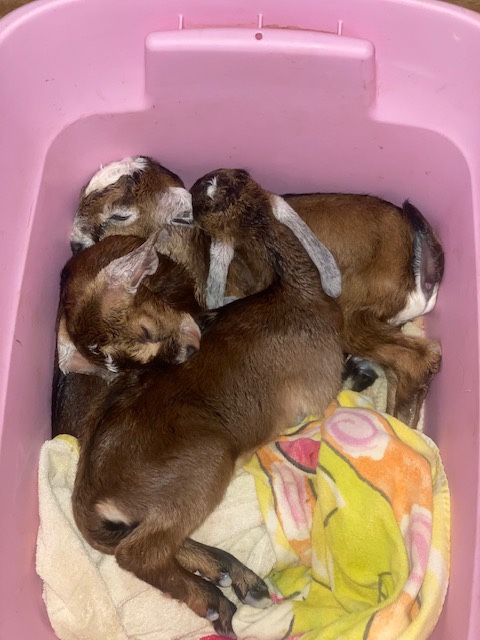
I was going to bottle raise the kids, and they would have a warm barn to live in by the time we brought them home in March. We’d raise them until they were yearlings and then breed the does during their second fall (Fall 2022). We had our livestock guardian puppy who was ready to meet her new friends. We were excited and had everything in order.
And then I got a phone call that changed everything.
My breeder had already called me the day after Killdeer kidded and threw the triplets, and we had made all the plans for pickup, etc… so when she called me a couple days later, I was surprised, and then she told me she had a proposition.
Several months prior to this phone call, Killdeer had gone to a goat show. The long story short is that the show was overcrowded, so the powers that be moved some goats out to a gravel parking lot while they waited to be seen in the show. Killdeer was one of these goats. Gravel is not good for goats to walk on, and my breeder tried to use a deep bedding system for her goats out in the gravel. Unfortunately, the deep bedding wasn’t deep enough, and Killdeer split a hoof on the gravel. This, my breeder informed me, effectively retired Killdeer from show life. And because her livelihood is based off breeding, showing, winning, and selling goats, and Killdeer was never going to win another show with a split hoof, the breeder had to make the difficult choice to sell her. She only has so much space on her land, and a show goat who can’t be shown isn’t as valuable toward her livelihood as a goat who can win championships. Killdeer’s injury would be my gain.
Now, Killdeer is still a perfectly healthy, normal goat for living on a farm. In fact, her hoof will eventually grow out just like a human’s broken toenail. It just takes a year or so, and the breeder didn’t have that kind of time. She didn’t want to sell Killdeer, but she had to, and she wanted to find her a good home.
For whatever reason, my breeder seemed to have a good impression of me and believed that I would provide a quality of care for the goats. I didn’t necessarily make any statements as to my knowledge or work ethic or make any grand promises to her beforehand, but maybe it was the way I furiously took notes in a notebook everything she said the day we first met her. Or maybe she just saw something in me I didn’t know I had. Either way, she wanted to sell Killdeer to me. A retired show goat, whose split hoof would eventually grow out and be just fine, who had just kidded, and was already in milk. And the breeder said I could come get her right away if I wanted.
Not only did she want to sell me Killdeer, but she offered me a better buckling for the same price we had agreed to on Blueberry’s buck, making the newly offered buck half the price. She also offered to send me home with the two bucklings that Killdeer had thrown, for free. If you think there might have been some kind of catch to this new scenario, I haven’t been able to find one. Some people are just kind and want to help others. I didn’t get a sense this was some sort of bait and switch scenario, and I still don’t. I would go back to this breeder and buy more goats from her tomorrow if Hubby would give me the okay (and if our farm budget would allow it).
We discussed over the phone all the logistics and payments, etc… and then I called Hubby. We were all in agreement, and so the end result is that we wildly pivoted. Instead of the original plan, we bought Killdeer, Taffy’s buckling (the more expensive kid), Killdeer’s doeling, and we got two more bucklings for free. We would most likely sell one of them and keep one as a wether, and we would travel the following weekend to pick up all five goats.
That meant that instead of having one more month to get everything built and ready for the goats, we had just seven days. To catch up on the how and the why of fixing up a barn and running pasture fencing in an ice storm we didn’t see coming, read “An Old Barn and a Frozen Flock.”
In that week’s time, we managed to get the barn fixed up enough for the goats to live in, but we did not have time to build something we didn’t think we’d need for a year or more: a stanchion.
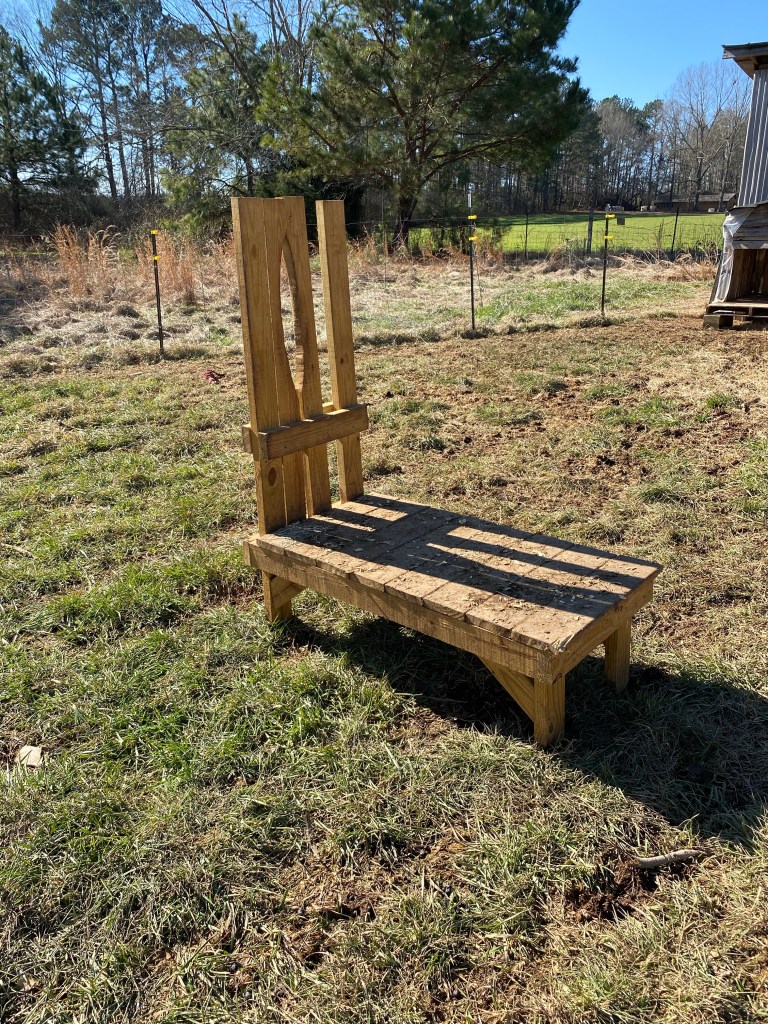
A goat who has just kidded is going to come into milk. Killdeer was a second or third time freshener, so she knew the game, but she wasn’t used to being milked by hand. She came from a big-time show goat operation, which, in my opinion, is the Taj Mahal of milk rooms and barns. Maybe not as elaborate as a commercial dairy farm, but definitely fancier than anything we have on our little farm. Lighting, heat, commercial milking machines. I have a pail and my two hands. And I needed a milk stand.
We could have purchased one, but good ones are expensive. And even if we purchased one, it probably wouldn’t have arrived in a week’s time. We could have bought a kit, but it would still take time to put it together. We decided to build it from scratch. Only, we ran out of time because of all the other minor emergencies that happen on a daily on a farm. The stanchion just didn’t happen on time. Sometimes in farming, it’s about putting out the big fire and letting a smaller one burn, if you can let it. In this case, it could burn some.
So we drove the three hours to the breeder to pick up our five goats, and we loaded Killdeer into the back of our minivan. We laid the back seats down and made a bed of pine shavings atop a big, blue tarp for her so that she’d be comfortable. The breeder cried; Killdeer was one of her favorite goats, and she didn’t want to sell her. She knew she’d have a good home with us, but it was still hard to say goodbye. We were promised a sweet, gentle goat who’s a good milker. Not necessarily used to kids, but she’d be okay.
Hubby drove, and the kids and I each held a baby goat in our laps the whole way home.
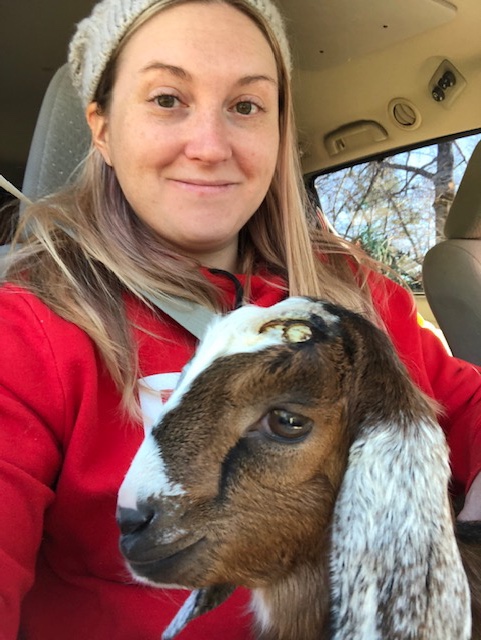
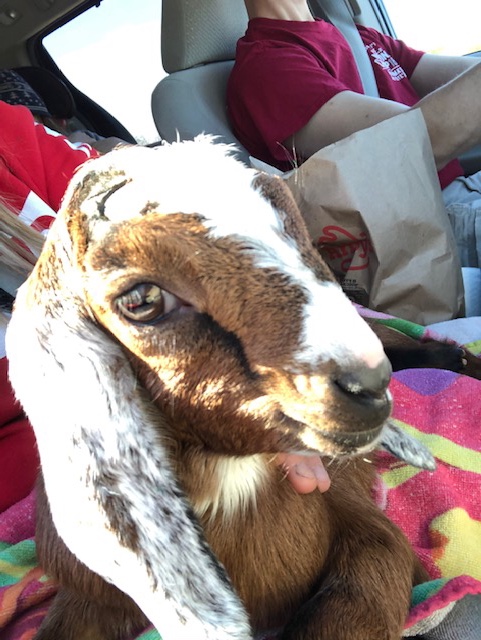
We knew that we’d have to milk Killdeer when we got home, but we weren’t quite sure how we were going to get that done without a stanchion. We tried to think of ideas the whole drive home, and we didn’t come up with much. Mostly we were overcome with the cuteness overload that was riding in our van. That, and the occasional “Meh” that was coming from the back.
It was after dark by the time we arrived on our farm.
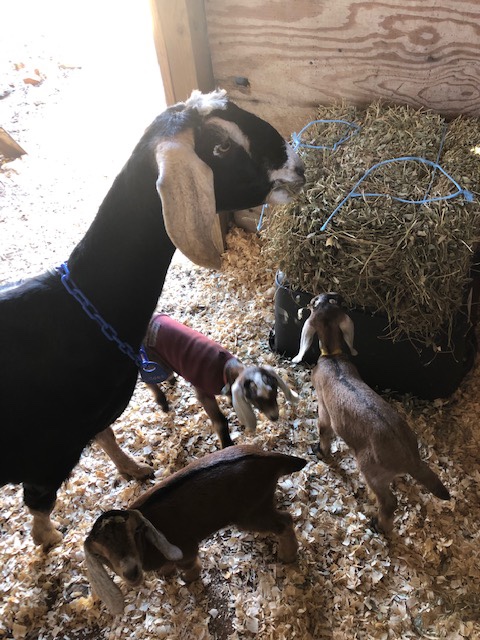
The goat kids went to the barn and got bottles of warm milk. The kids had a blast holding and feeding the babies. At first we put caprine nipples on aluminum beer bottles, but feeding four goat kids three times a day that way became very labor-intensive, so we eventually switched to a faster ten-kid bottle-bucket feeder situation, which sped up feeding time tremendously. But in the meantime, the bonding experience was great for everyone.
Once the goat kids were settled in the barn for the night, Hubby and I had to figure out a way to milk Killdeer. With no milk stand. A goat isn’t just going to stand there and let a stranger touch her udders. She had just met us, and she wasn’t about to be that vulnerable. Not to mention, I had never milked a goat before. The breeder had given me a lesson, and I had managed to get milk from a goat’s udder before we left the breeder’s farm. But that’s a whole lot different of a scenario when the goat has her head locked in a stand, with a tub of grain in front of her to eat, she’s comfortable, and the milk maid knows what she’s doing. I had none of those things.
Our kids went to bed, and Hubby and I got to work on getting Killdeer milked. It’s not like we could skip milking her. She had been milked at 5:00 that morning, and it was already past 6 in the evening when we got home. She wasn’t happy, because she was used to a specific schedule of being milked every twelve hours, in the warmth of a pristine facility, with her person nearby, and now she was with strangers, in the dark, not yet milked, and well past her comfort level. Poor Killdeer. Poor us.
So, what to do with no stanchion, two grown adults, a milk pail, and an irritable dairy goat? Try to hold her still, bribe her with goat treats, and milk her on the back porch of our house, of course. We needed light, and the barn doesn’t have electricity. We needed a stanchion, and we only had Hubby’s arms and body strength to throw everything he had into wrangling the goat. Have you ever tried to hold an angry 150-pound farm animal still with nothing but yourself? My husband has.
Hubby set his feet and hugged Killdeer around her head and as much of the front of her body as he could. I sat on the porch steps and did my best to milk her. I wish I had pictures or video to share so you can get a mental image, but it was just us, so there was no one to record it. That might actually be a good thing, though. The depths of our ineptitude probably would have caused our goat breeder to rethink the entire thing, had she seen us in that moment.
I had purchased a set of milk pails months prior, and I hadn’t really taken a good look at them when they arrived, or maybe I had overestimated the distance from a dairy goat’s udders to the ground. But either way, the milk pails I ordered weren’t going to work. They wouldn’t even fit under her body. I had purchased milk pails for a cow. How this fact escaped me, I’m just going to blame on the devil.
I didn’t have the right size pail, I didn’t have a stanchion, it was cold outside, and my poor husband was trying to hold this angry goat still long enough so I could milk her. Did I mention that the way I was taught to milk a goat is by sitting right behind her hind quarters? Goats have two udders, not four like a cow, so the easiest way to milk a goat is to sit right behind her. Or at least it is for me. Now. But there are hooves back there. The importance of your goat trusting you so she doesn’t buck and kick you in the face while you’re back there cannot be stressed enough. You do not want to be kicked in the face by your dairy goat.
In the battle of goat versus humans, it came down to the sheer force of each of our own wills as to the outcome. Killdeer had to be milked, and we had to be the ones to get it done. We were in this now. No going back.
I found a stock pot small enough to fit under Killdeer so that I could get the milk into a container, and eventually we had developed a pretty good rhythm. After getting pushed, shoved, and slung around the back porch for what felt like hours, Hubby had finally earned Killdeer’s trust enough that she would stand still for the most part. He discovered that singing and talking in dulcet tones was what helped the most. They were bonding, and that helped me. The softer he spoke to her, the calmer she was, and the faster I was able to milk.
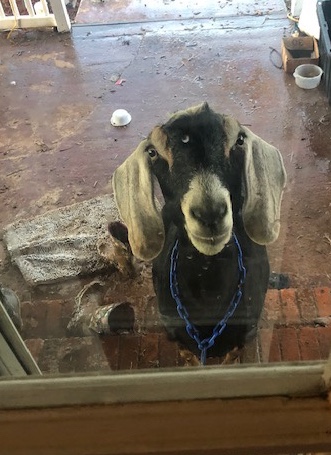
But no matter how sweet and intimate my husband’s newfound relationship with this goat was becoming, he couldn’t keep her calm indefinitely amidst the nighttime sounds of the country, out in the open air, away from a safe, familiar barn.
Goats are prey animals, and Killdeer does not like being out past dark. We have come to find that if we are late getting home from somewhere and night has fallen before we’ve put her to bed, she has something to say about it. The chastisement from a dairy goat is nothing short of both embarrassing and hilarious. Poor Killdeer. She’d teach us a thing or two; we’d get the hang of this, we promised her.
We had gotten a good rhythm, albeit a slow one. And then a dog barked, a car drove up the road too fast and too loud, etc… Something upset the goat. She kicked the pot full of milk, spilled it all over the porch, and all that work was wasted. At this point, we were all just over it. We were all exhausted. I continued to milk her, but this time I just let the milk spray onto the porch. So much was lost already, there was no salvaging even a cup’s worth of milk at this point. I lamented, “There goes an $800 pail of milk.”
It wasn’t easy, but we got the work done. And in the process, Killdeer came to love Hubby. They developed a bond during that evening with him singing and talking sweetly to her. If you ever want your heart melted, watch your husband soothe a scared dairy goat. It still remains as one of the most tender moments of our time on the farm thus far.
We reunited Killdeer with the four goat kids and the puppy in the barn, and we set our sights on our next project, which had to be done that night. We had to build a milk stand. Hubby had to work the next day, and I couldn’t milk her by myself without a stanchion. (Come to find out, I’d have enough trouble even with a stanchion, but that’s a story for another day). We got the milk stand built that night, by about midnight or so, and we hauled it to the back porch. That was as far as we could move it; we were beat. Time for bed.
The moral of the story here isn’t as deep as some other lessons we’ve learned, but we did deepen our resolve to do hard things. We don’t give up. We don’t throw in the towel. This was just the beginning.
If we could wrangle a goat and get her milked without a stanchion, replace rotten subfloor with miraculous workshop shelving, fix a barn and run pasture fencing in an ice storm, and rescue freezing chickens, then surely everything else would fall into place. Right? That’s what I told myself as I slipped into sleep that night. The rest was all downhill.
Not so.
The anguish I would feel during the next chapter of this story is not something I want to revisit, but there is healing for me in confronting the pain, and we’ll get there. For now, in this place, I saw it all as a victory, and that’s a good place to stop for now.
 Blessed Roots Farmstead
I love this part of your story so much! ♥️♥️
LikeLike