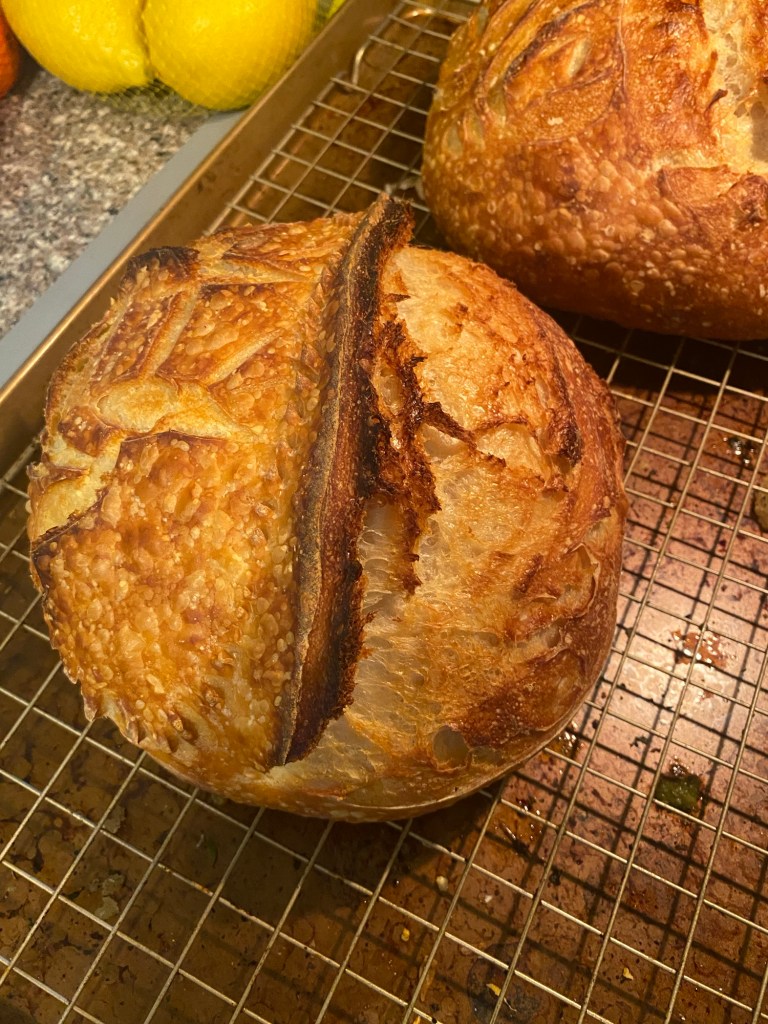
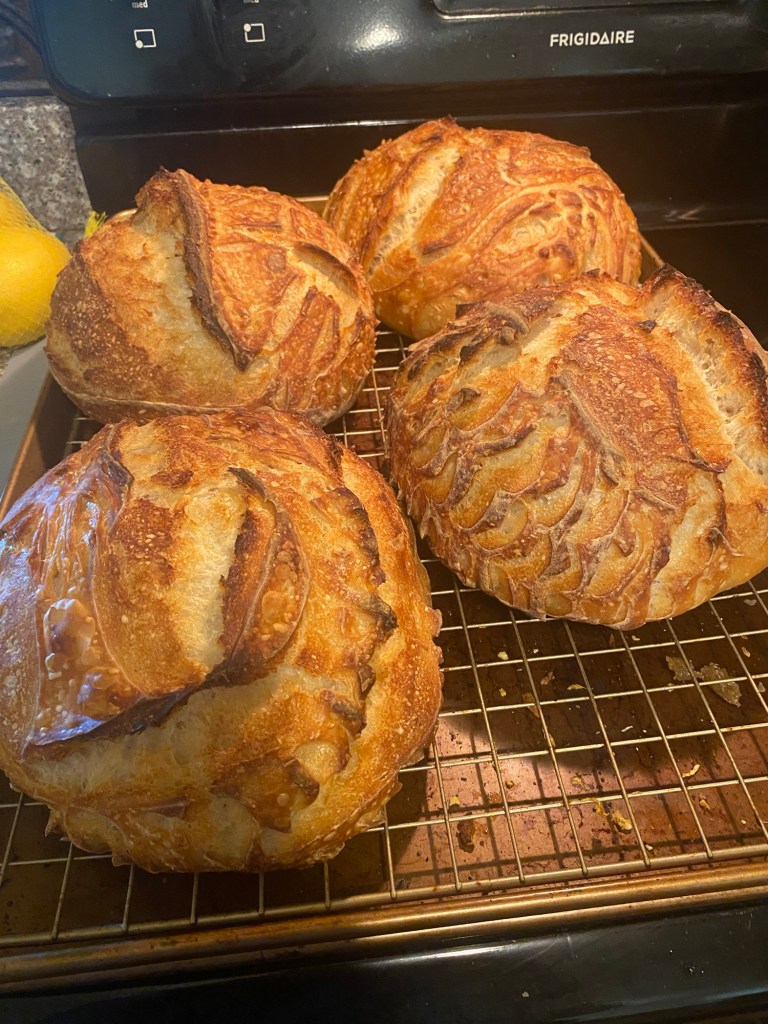
My daughter and I have been on a sourdough journey since last November.
I had a major surgery November 30, 2023, followed by a 12-week recovery. It was supposed to be eight weeks, but complications slowed down the process.
It was a long road.
Part of that trek involved watching a lot of shorts on various social media platforms, which led me to discover some sourdough videos. One sourdough reel turned into another, and before long that was the majority of what I saw. Thanks goes out to the Algorithm.
We wanted to make beautiful designs in bread. At least that was my daughter’s primary goal. I think she enjoys decorating the ready-to-bake dough much more than the laborious process of getting it to that point. But that’s okay because I am very much enjoying the labor-intense part.
So, naturally, since beginning this sourdough journey, I’ve been thinking a lot about bread.
First off, I didn’t really understand that sourdough takes a while to get going. I kind of knew it in theory, but not the way I do now, which is still limited. In the past, friends have even given me starters, which I asked for, but by which I was immediately overwhelmed, causing me to stuff the Mason jar full of potential into the back of the fridge until I could develop the capacity and bandwidth for devoting the time and attention necessary to maintaining its life, but then eventually forgot about, until months later when I was cleaning out the fridge and discovered anew the poor, neglected, little starter that I mistakenly diagnosed as dead. And then regretfully, mournfully threw in the trash.
I just wasn’t ready for that kind of commitment.
There was a time when the idea of fresh bread every day sounded wonderful in theory, but I just couldn’t get it off the ground. Rather, I couldn’t get my act together enough to remember to feed the starter every day. And even then, how much to feed? Which flour is right? How much water? And is the starter on Day 2, or Day 7, or does that even matter at this point? Do I feed bread flour on the full moon, or was it whole wheat, but only on odd numbered days? It was too much.
Back to buying bagged bread at the grocery store.
At $5 per loaf for the “good stuff” without corn syrup, maltodextrine, and soy, I could have just bought a bakery. I should have bought a bakery. It would have been cheaper, with as much bread as my family eats.
As a farmsteading, off-the-beaten-path, herb-foraging, plant-medicine-making, goat-milking, chicken-keeping, rabbit-raising, soap-making wildling, sourdough was that elusive homesteading pipe dream for me.
People say that once a woman makes a sourdough starter, she’s about to buy chickens. But I guess I sort of did that backwards and just got the chickens. And then the goats. And learned to make soap. And then herbal remedies. And then lastly, sourdough. I never thought I’d jump on the sourdough bandwagon again once I gave it up the first… second… third… time.
I did it backwards, it seems.
I mean, we can’t do it all, can we? I was willing to let go of the sourdough dream. I had plenty else to occupy my mind and my time.
That is, until my middle daughter started watching sourdough bread design videos and expressed interest in doing that herself. And then she added a sourdough kit to her Christmas wishlist.
Okay, then… Here we go. Again.
Well, I’d mistakenly tossed the last sourdough starter my friend had given me (kept the jar though), and I didn’t feel right asking for another one. So I thought, “Well, we’ll just make one! How hard can it be!?”
If I thought maintaining a starter was difficult, starting one from scratch was going to be so much worse.
Any chance I could reach back far enough into the fridge and find 2021 again?
“Sure, right next to all your (at-the-time) unresolved childhood trauma, codependency, and anxiety, so maybe just pull your hand back and start over.”
If the only unresolved issue I left in 2021 was a jar of sourdough starter, there are worse things to be upset about. I’ll take emotional healing for $1000 of therapy, Alex.
Sourdough starter has to be made from seemingly nothing. Flour, water, and time. How a glob of paste (which, oddly enough, was the base of my very first attempt at making body lotion when I was 7 years old… the third ingredient was my Mom’s very expensive Poison perfume – sorry, Mom) could become a living organism capable of leavening bread, I still don’t know.
Mix, wait 24 hours, pour out half of it, add more flour and water, wait another 24 hours, do it all again the next day. For days.
Accidentally grow mold. Start over.
Repeat.
Repeat.
Repeat.
Give up, and buy a dehydrated starter online. Feel like a sourdough failure.
Get over it.
Because bread.
And daughter who wants to make bread already.
A few days ago, we really began to truly bake bread. Only, I still really didn’t know what I was doing.
I’ve made bread before. Add all the ingredients, throw in some active dry yeast, toss it in the oven, and voila! Bread!
While a convenience of the modern age, I’m pretty sure it wasn’t always this way. But in my ignorance, I believed that baking sourdough would be the same as baking a cake.
Easy, right?
If only…
So all that to say, the process surprised me in just how long it takes to not only get the sourdough starter started, but also to even bake a single loaf of bread.
It’s more than bread. It takes up a fair corner of the interwebs, Reels on Instagram, pins on Pinterest. It’s a whole movement. A way of life.
Bread is life, after all.
Scripture has so much to say about bread. According to an internet search, the King James Version of the Bible mentions the word “bread” 330 times. For comparison, the KJV uses the word “holy” 611 times and the word “love” 442 times. So it’s not an insignificant amount of times we see bread in God’s Word.
Bread is seen throughout the Old and New Testaments, in reference to food, survival, fellowship, hospitality, provision, God’s presence, Bethlehem, Jesus, and life itself.
Adam was told that from the day he and Eve were cast from the Garden of Eden that he would have to work by the sweat of his brow, meaning he would have to grow food for his own survival.
Abraham asked his wife Sarah to make bread for their visitors in Genesis 18:6 as a sign of hospitality and fellowship.
Manna was given to the Israelites in the desert (Exodus 16:33) as God’s provision for His people. They kept it in jars, by the way, which is only relevant because we keep sourdough starter in jars, too. Just a little anecdote I found interesting.
Twelve loaves of bread were kept on the Lord’s altar at all times.
Grain offerings were given to the Lord after animal sacrifice, showing the covenant relationship between God and Israel. Other times covenant relationship are mentioned are found in Genesis 14:18-19, Psalm 110, Matthew 26:28, and Hebrews 9:15.
The bread of the Presence in the Holy Place (Hebrews 9:2) was a sign of God’s very presence with His people.
David used bread as a means of honoring his friend Jonathan in 1 Samuel 9:7.
Proverbs 6:6-8 says, ”Go to the ant, O sluggard; consider her ways, and be wise. Without having any chief, officer, or ruler, she prepares her bread in summer and gathers her food in harvest.“
Proverbs 4:13-18 states, ”Keep hold of instruction; do not let go; guard her, for she is your life. Do not enter the path of the wicked, and do not walk in the way of the evil. Avoid it; do not go on it; turn away from it and pass on. For they cannot sleep unless they have done wrong; they are robbed of sleep unless they have made someone stumble. For they eat the bread of wickedness and drink the wine of violence. But the path of the righteous is like the light of dawn, which shines brighter and brighter until full day.“
The Proverbs 31 woman ”watches over the affairs of her household and does not eat the bread of idleness.“ (Proverbs 31:27)
Bread is what we do. It is the choices we make. The ant considers the future and stores for herself what she needs. The righteous do not eat the bread of wickedness. The woman in Proverbs does not eat the bread of idleness. She chooses to do good for her family.
Jesus was born in Bethlehem, which means “House of Bread.”
Jesus was tempted by Satan in the desert, and He said to him in Matthew 4:4, “It is written, ‘Man shall not live by bread alone, but by every word that comes from the mouth of God.'” (Jesus was quoting Deuteronomy 8:3)
Jesus fed the 5000 with five loaves and two small fish in John 6, revealing His love, compassion, and provision for people.
Jesus tells His followers in Luke 6:38, ”Give, and it will be given to you. A good measure, pressed down, shaken together and running over, will be poured into your lap. For with the measure you use, it will be measured to you.”
In the marketplace, merchants would sell grain this way. They would measure it out, press it down, and shake it to make room for more grain. This is where the term “lap of luxury” comes from.
In Matthew 16:5-12, Jesus warns His followers of the leaven (the teachings) of the Pharisees and the Sadducees. Just a few verses later, Jesus asks His disciples who they think He is. “Simon Peter replied, ‘You are the Christ, the Son of the living God.'” (Matthew 16:16)
In John 6:34, Jesus states, “I am the Bread of Life. He who comes to Me will never be hungry, and he who believes in Me will never thirst any more.” Again in John 6:48-51, He says, “I am the Bread of Life. Your forefathers ate the manna in the wilderness, and yet they died. But this is the Bread that comes down from heaven, so that anyone may eat of it and never die. I am this Living Bread that came down from heaven. If anyone eats of this Bread, he will live forever; and also the Bread that I shall give for the life of the world is My body.”
It’s right after Jesus says this that many “drew back [and] returned to their old associations and no longer accompanied Him.” This is when Jesus asks the Twelve, “‘Will you also go away?,'” but Simon Peter answers Him, “‘Lord, to whom shall we go? You have the words of eternal life, and we have learned to believe and trust, and we have come to know that You are the Holy One of God, the Christ, the Son of the living God.'” (John 6:67-69)
Jesus broke bread with His disciples during the Last Supper, spoken of in the Gospels. He again told them that the bread He broke for them was His body. He was about to die, and He was telling them something vital.
Were they aware that everything was about to change? Or did it just seem like another day with Jesus? He had told them so many things; did they know? Was there a different feeling in the atmosphere around them? Or did they think that He would always be with them in physical form, walking beside them? I have the ability to read all of these accounts after they’ve happened, but what if I had been there as it happened? Would I have known? Would I have sensed something? Would I have been totally clueless? Would I have been like Peter and denied Him? With the benefit of hindsight, it’s so easy to see how the story unfolds, but when we’re in the middle of something big, I think we so often fail to realize that it is, in fact, that big.
I think I wouldn’t have really gotten it until well after everything took place. I’d have had to sit with the gravity of everything I’d witnessed over those three years before it could all sink in.
Jesus went to the cross as the spotless Lamb to spill His blood for the atonement of all mankind forever. He was also the Bread of Life, given as an offering in obedience to His Father. In the tradition of sacrifice for atonement for sin, as outlined in the Old Testament, the animal sacrifice precedes the grain offering.
Jesus is both.
After Jesus’ resurrection, He appeared to many. One such account is found in Luke 24:13-35. Two of the disciples were on the road to Emmaus, about seven miles from Jerusalem, and Jesus was among them. However, they did not recognize Him. They walked and talked together, and that evening they had dinner together. Jesus took a loaf of bread, praised God, gave thanks, asked a blessing, and then broke the bread. Then “their eyes were opened and they recognized Him, and He vanished.” (Luke 24:31)
They went back to Jerusalem to tell the Eleven (apostles) and said, “The Lord really has risen and has appeared to Simon (Peter)!” (Luke 24:34)
They shared “how He was known and recognized by them in the breaking of bread.” (Luke 24:35)
Whether the bread referenced was literal food or it was Jesus referring to Himself as bread with a capital B, bread means life.
Jesus is the Bread, and He is also the Way, the Truth, and the Life.
Knowing the Truth awakens us to Life in Him. We see more clearly. We see Him. We see ourselves in relation to Him.
I see that I am a wayward, blind wretch without Him. A sinner in need of the saving grace of Jesus, who poured out His blood on the mercy seat for me. A starving soul in need of the Bread of Life.
For me, it adds new meaning to the Lord’s Prayer: “Give us this day our daily bread.”
Daily bread.
And here is where it all comes back around to sourdough.
Sourdough bread takes days – not minutes – not even hours – to see the fruits of that labor. This is where I was confused when I first started this whole thing.
I have a mature sourdough starter that was fed the day before, but over the course of the day and night, the starter has since fallen. There’s a cycle of rising and falling with the starter.
So I wake up, decide what type of bread I want to make, and measure out the amount of starter I need for that recipe. I pour that starter into a different jar and add the amount of flour and water needed for that particular dough. This is how I make a levain, which is the leavening agent for the bread. It takes a few hours to reach a peak rise, where it about doubles in size. Then it’s ready to add all the other ingredients for that day’s dough.
Now the remaining starter from the original jar needs to be fed again. So I add more flour and water to that in order to start the cycle of rising and falling again. That starter will double in size just like the levain, but I won’t use it again until tomorrow.
Feeding it today keeps it alive for tomorrow.
Now I can bake bread. But I’m not baking bread that I prepared today. No. The levain I made this morning will be used for tomorrow’s bread. The bread I’m baking today is the dough I made the day prior.
What I prepared yesterday determines what I can bake today. And what I make today determines the bread I can bake tomorrow.
The same is true for my spiritual life. That’s not to say that I can’t start over, as each morning brings His mercies anew, and that’s not to say I can’t begin right where I stand in this moment. I can always seek forgiveness and start fresh with each breath I take. But it does help me move through difficult days tomorrow when I’ve already banked time with my Savior today.
What feeds my soul today will help me rise well tomorrow. If I do that every day, I’ll never be hungry again.
Jesus is the Bread of Life. When I feast on His Word, I am filled with His presence and His truth, and that will sustain me when this life on Earth is tough. Because it’s always tough.
If I am like the little sourdough starter that longs to be fed with more of this life-giving flour, then when the falls come my way, because they always do, I will still have enough life in me to keep going and rise again.
Not because of anything I’ve done to save myself, but because I’ve been saved by the One who died in my place and rose again. He gave everything of Himself so that I might live. So that we all might live.
I must feed my heart, mind, and soul with the Bread of Life every day (not that I must be re-saved each day, as though it’s something that could be lost), but if I want to stay an “active, mature starter,” then I must allow myself to be fed and to stick close to the Source of my sustainment. If I don’t, I’ll either end up like the dormant, long-thought dead starter in the back of the fridge, doing no good for anyone, or worse, the moldy starter on the counter, full of deadly poison.
Jesus is the Bread of Life, and I’m hungry for more of Him.
I can’t think of a better day than Good Friday to “taste and see that the Lord is good.” (Psalm 34:8)

 Blessed Roots Farmstead