I told a friend the other day that I feel like I’m walking the in-between.
The in-between… How do I begin to describe this? Sometimes words are hard, and sometimes they escape me. But I’m going to try.
Maybe that’s part of living in between two places.
A place of radical acceptance for what is and a place of desire for what it could have been but isn’t.
While I was in therapy, my counselor told me to practice saying this: “It is what it is, but it’s not necessarily what I want it to be.”
Acceptance with a lamentation.
“It is what it is.”
There’s the acceptance. I can see the situation with clarity. I see the person for what they are. I can’t unknow what I know. I can’t unsee what I can now see. While I may have had blinders on for a long time, they’re off now.
The behaviors that never added up;
made me feel off-balance and crazy;
like it was just my perception that was off,
that I misheard, misread, or misunderstood;
like I was the one at fault
or the one deserving of it;
as though I’d chosen the abuse for myself;
as though I just wasn’t being gracious enough;
and that love should cover a multitude of unacknowledged, unrepentant, unchanged abuses — those behaviors now make sense in the light of day.
And as much as part of me would love to put those blinders back on and go back to living in the dark of denial, I can’t.
It is impossible.
To go back would mean to willfully ignore the patterns of behavior that were detrimental to my mental, emotional, physical, and spiritual health. It would mean denying that this person was affecting my walk with the Lord and leading me down the path to Perdition. If, when I’m around this person, I act more and more like them and less and less like Jesus, who is my god? God, or them? If, when around this person, I make excuses and a thousand little justifications for them and their behavior, am I loving them to Jesus, or am I loving them to hell?
To walk back the boundaries I set for the sake of the relationship, when that relationship was built on the foundation of enabling my own abuse, as well as immoral behavior that’s affecting my Christian walk and psyche… That would be me willfully telling the person, “It’s fine, and in fact, I encourage you to treat me badly. There is no standard; you can say whatever you want, do whatever you want, and act however you want toward me and my family with impunity. I won’t say anything; I will remain silent in the wake of your abuse and force others into silent acceptance as well.”
Friends, this is not how we love people for Jesus, to Jesus, or as an example of the way He loves. Jesus spoke truth to those around Him, and He allowed people to walk away from Him. He held people acccountable. He told people to “go, and sin no more.” The rich young ruler walked away; the Pharisees rejected Him; His own disciples denied Him and fell away. Jesus knows what it means to be mistreated, abused, despised, and rejected. That doesn’t mean He thinks it’s okay for us to be abused, or that abusers get a free pass to abuse; it means that people will be abusive, especially if we follow Him.
Christians are called to love, but we are also called to accountability within the scope of that love.
We cannot just act however we want to and think it’s okay. God has a holy standard, and we all fall short of it. That is why there is grace, mercy, and forgiveness. But we don’t receive grace, mercy, and forgiveness so that we can keep on living lives that hurt other people, ourselves, and break God’s heart. That would be a misuse of the very grace Jesus gives us. We are free, but that doesn’t mean we are free to do whatever we want. All things may be permissible, but that does not mean all things are beneficial.
It is not loving to revile, slander, mistreat, cheat, deceive, or otherwise abuse another person. In that same vein, it is not loving to just accept that sort of behavior and let it slide. We are to be as iron sharpening iron. We are to go to the person who has mistreated or offended us, to attempt to work things out, speaking truth with love. And if that person won’t change their ways, won’t listen to you or others? What do we do, then? Matthew 18:15-17 says to treat that person as an unbeliever and to move on.
There are other examples of Paul “shaking the dust” from his feet and/or clothes and moving on when people would not hear and heed truth.
In fact, Paul, in 1 Corinthians 3-6, speaks for quite a while on how Christian brothers and sisters are to conduct themselves toward one another. He also has instructions for what we are to do if someone within the midst of Christian brotherhood won’t be reasoned with or persuaded to change their behavior. There were wolves in sheep’s clothing back in Paul’s day, and there are wolves within our midst today. We must be on guard, alert, and with eyes open to the truth, and we must be willing to call it out, God’s way, when we see it.
We are responsible to conduct ourselves according to our beliefs, and, “If possible, as far as it depends on you, live at peace with everyone” (Romans 12:18). We are to, “Continually pursue peace with everyone… [and] See to it that no one falls short of God’s grace; that no root of resentment springs up and causes trouble, and by it many be defiled” (Hebrews 12:14-15).
How do we pursue peace, while also seeing to it that no one falls short of God’s grace? By holding one another accountable, with honesty, sprinkling in love, grace, mercy, and forgiveness. But we do have to speak the truth.
It sounds unloving, unChristian, and unkind to tell people the truth… but we can’t just act nice to everyone with our mouths shut, hoping that others will know what we believe and why we live a certain way and that one day they’ll just magically have a change of heart. Those who mistreat and abuse others will not just have an epiphany one day and snap out of it because you loved them well and took their abuse with a smile.
We are called to live according to God’s Word. We will all fail, so we are called to give grace and forgiveness, and to live in peace. We are called to accountability, humility, and striving ever more toward Jesus and being like Him.
So what happens when we are in relationship with people who say they love us but instead show us they don’t with repetitive actions counter to the very definition of love?
What happens when…
“It’s not necessarily what I want it to be”?
Paul says to not associate with them (Ephesians 5:3-7), to turn away from them (Romans 16:17), and to avoid such people and keep far away from them (2 Timothy 3:1-5).
That sounds harsh. But for far too long we’ve lived under a church-y ideology that abused people in toxic relationships just have to suck it up. I’ve heard, ”But it’s your dad…” or “But they do __ in church…” So because it’s a family member or someone who does things around the church, they live outside of accountability? By no means.
We must lovingly hold each other accountable, in and out of church, in our personal lives, in our businesses, in all our relationships, and not just when others are watching, but always. And if the other person in the relationship is truly someone who loves others and wants to show genuine love, then that person is going to feel remorse for their words or actions that were harmful, and then that remorse will be followed with a sincere apology, and, most importantly, changed behavior moving forward.
If it’s not, then oftentimes the choice is made for us. Sometimes that person chooses to walk away because they won’t change their behavior or respect a boundary. Sometimes they walk away through stonewalling and silent treatment in an attempt to punish us. Maybe they slander us and try to rally others to their side. Whatever the tactic, we don’t have to stoop to that level of behavior. I think this is where that “as far as it concerns you, live in peace” thing comes in.
I accept what is — that someone has chosen to walk away, to stonewall, to refuse to acknowledge hurt or take responsibility, to refuse to apologize, to refuse to change behavior… I accept that.
And I acknowledge that it’s behavior and mistreatment that I’m no longer willing to abide in. I have forgiven time and time again. I have overlooked. I have made excuses. I have set boundaries without consequences. I have begged. I have pleaded. I have smiled. I have loved. I have spoken truth. I have had enough.
So I have let them walk away. It is what it is.
But that’s not what I wanted. What I wanted was a shared road toward the same destination.
What I wanted was mutual respect.
What I wanted was accountability.
What I wanted was acknowledgement of hurts that have been caused.
What I wanted were sincere apologies and changed behaviors.
What I wanted was a healthy set of boundaries.
What I wanted was a relationship.
What I wanted was a friendship.
What I wanted was acceptance.
What I wanted was love.
Joy.
Peace.
Patience.
Kindness.
Goodness.
Faithfulness.
Gentleness.
Self-control.
Acceptance and lamentation. That’s one side.
So here is the other side of the in-between place I walk.
I still want these things. I still feel these things. I have not written them off. I love them with every fiber of my being. I pray for them. I forgive them. I want a relationship and a friendship with them.
I hope for them to open their eyes to truth and find Jesus. I pray for them to know the kind of love I know that only Jesus can give them. The kind of love that changes us from the inside out and makes us something entirely new in Him. I hope for it. I pray for it. I want it for them. But I can’t make them want it.
And until that day that I hope and pray for, I cannot abide in the abuse and call it good when it is anything but.
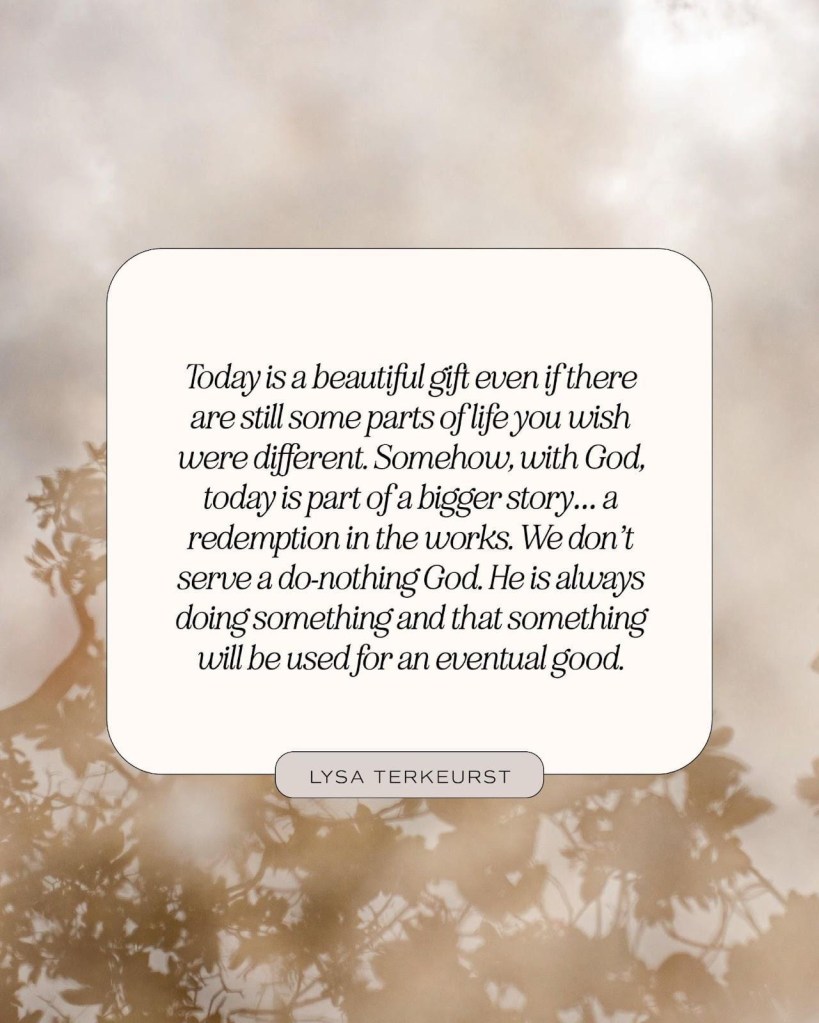
So instead, I say, as Lysa T. says, “Goodbye. Goodbye. God be with you. Goodbye.”
“It is what it is, but it’s not necessarily what I want it to be.”
And I’m going to add something to my counselor’s line: “so I pray, because I love them, that someday they will see the truth, and until then, may God keep them.”
 Blessed Roots Farmstead